The piece
Two technicians on a snowbound ridge, and the repeater every firefighter on the line depends on.
Originally published by the Washington State Department of Natural Resources, July 2026, on Ear to the Ground. Reproduced here as a writing sample.
“Twenty-nine years,” Jarrod Nordloh says. I glance at DNR's head of radio operations, hands resting easy on the wheel of one of the Ford F-350s the department has built out specifically for this kind of work. The truck is hauling a snowmobile on a trailer behind us, which you feel on every seam in the road. “Twenty-nine years I've been doing this kind of work.”
We left Tumwater an hour ago, the shop still dark when we loaded up. Eight of DNR's 15 radio technicians are based there, and the place has the organized chaos of any working garage: equipment on benches, radios in various states of assembly, the particular smell of metal and cold concrete.
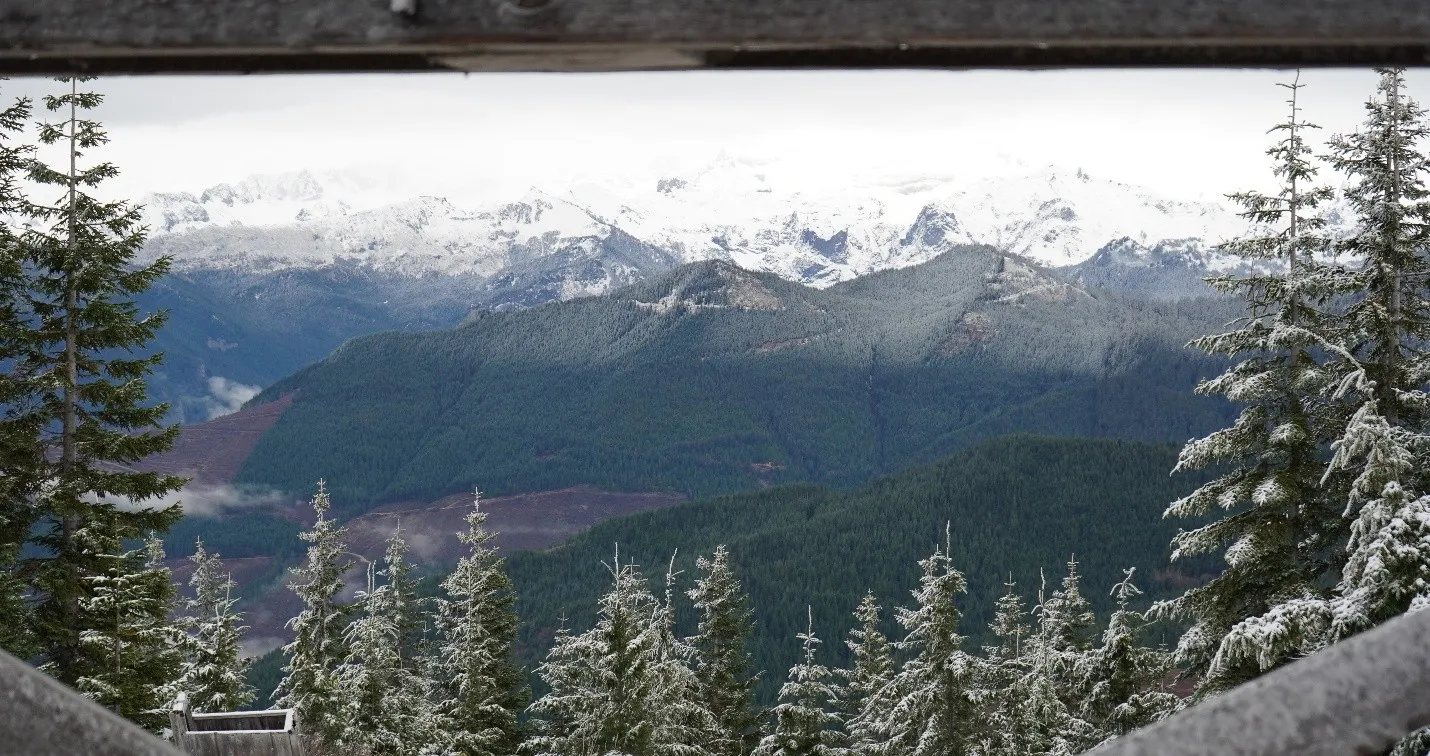
Jarrod didn't arrive at Radio Operations through any obvious door. Starting at DNR as a mechanic fixing fire trucks, he relished the proximity to action as well as the fabrication aspect of the job. He'd taught himself welding by then, and it was his skill with a welding torch that brought him to the attention of Radio Operations. “I loved playing with Legos as a kid and building things from scratch,” he explains. “One day the Radio Operations guys came over and suggested I switch to their team.” The radio work scratched at his Lego itch: the satisfaction of understanding how the pieces connect to make something function. What he didn't anticipate was the scale the work would eventually reach. These days Jarrod's invited to coordinate fire responses at the National Interagency Fire Center in Boise, Idaho: invited, not assigned. This is a big deal in fire circles. NIFC is the national body that writes the rules for how every wildfire in America gets fought and communicated. If you're called in, people know your name. It's elite-level work and a long way from a mechanic's bay in Tumwater.
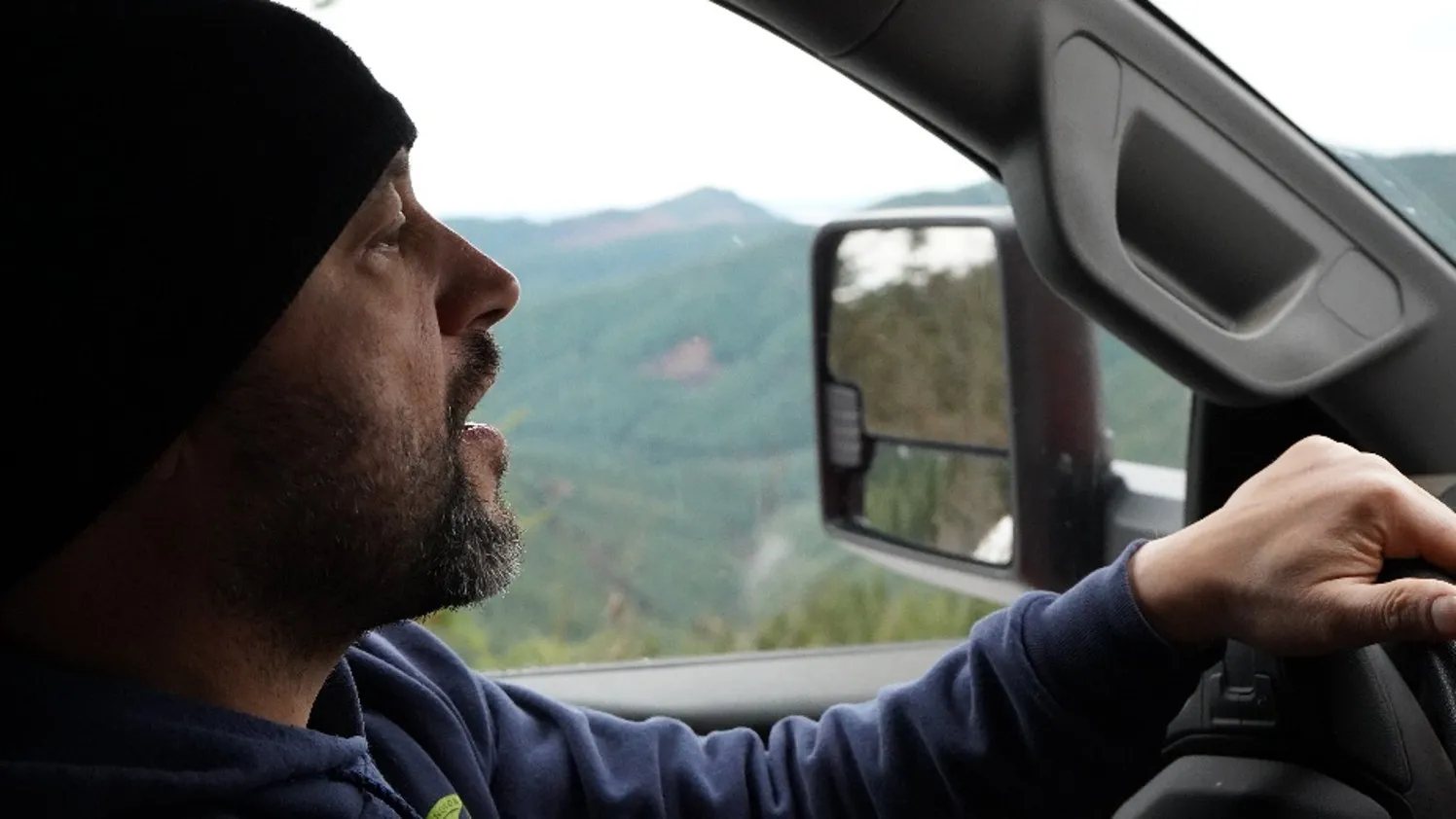
Bryan Torian's path here was even less direct, as we'd discussed while Jarrod attached a snowmobile trailer to his truck. Bryan studied hydrology for a time. He spent time as a geoduck harvester as a Surface Supply Diver, using a pressurized water hose to suck the giant bivalves from the seabed. At no point did Bryan appear to be on a trajectory towards setting up massive radio systems for a living and, given his fear of heights, climbing towers.
The fear of heights, Bryan decided, was a problem best solved by climbing things. So he took up rock climbing. He was never very good at it, he'll tell you. But somewhere between the rock face and his own stubbornness, the height stopped being a problem. Tower climbing came naturally after that. “Now I'm a land mobile radio technician,” he said, when I asked him to describe the job, “maintaining radio systems for foresters and wildland firefighters.” He admits, “I do miss diving at times. Going down to the water in the morning.”
We're northeast on Highway 7, the Nisqually River flashing through the trees to our left. Bryan Torian is somewhere behind us in a second truck. He's the Puget Sound Region technician, based out of Tumwater, and today's site falls on his territory. We're heading to a tower on Puyallup Ridge which serves as both the South Puget Sound Eatonville Area repeater and the State Rainier repeater. Something fell off it, making a small hole in the roof. However, given the banks of tech in these huts, this needs an urgent patch. Definitely a two-person job, Jarrod had said. He brought the snowmobile, because in this kind of work in this kind of country, you plan for what you can't see coming.
Jarrod tells me that sites like the one we're heading to can only be reached by snowmobile from around mid-October, sometimes earlier. “The landscape looks extremely different under snow,” he says. “Very easy to get lost.” He pauses, then notes that logging can also make a once familiar environment look completely alien and complicated to navigate. The highway passes through Eatonville: a coffee stand, a hardware store, a speed limit that briefly pretends we're somewhere civilized. Then the forest closes back in. Douglas fir mostly, some cedar, the understory dense and dark. Alder Lake appears through the trees, gray and flat in the morning light. The trailer rumbles behind us.
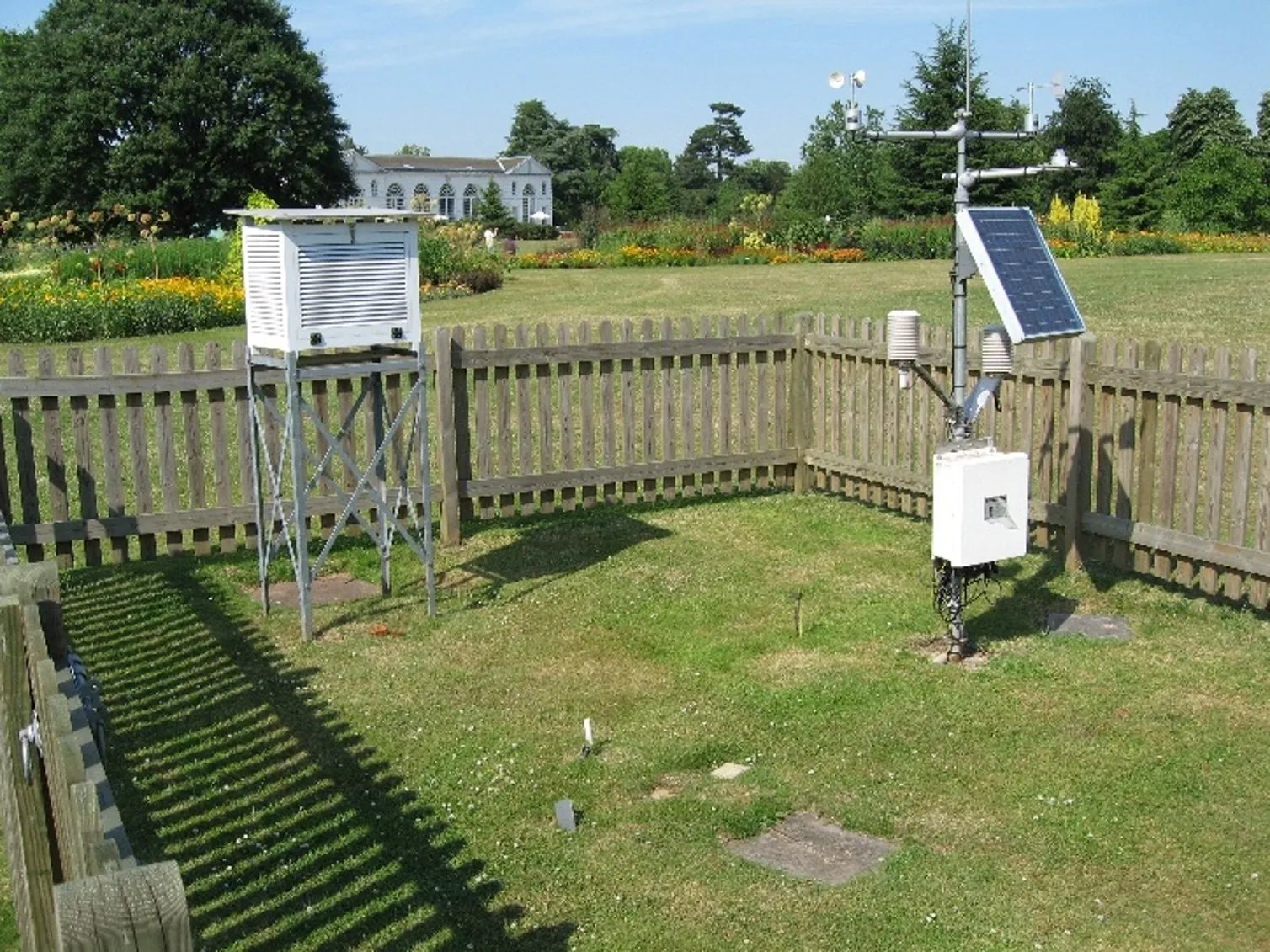
Somewhere out there among the trees, if you knew where to look, you'd spot a weather station. DNR hosts a number of these units across Washington as part of a national network known in the fire management world as RAWS: Remote Automated Weather Stations, solar-powered units mounted on tripods that NIFC's own fact sheets describe as looking like little lunar landers.
DNR deploys and maintains its own fleet of them across Washington, feeding data into a system that stretches from here to Boise. Every hour, each one sends up a pulse: wind speed and direction, precipitation, temperature, humidity, fuel moisture, traveling via satellite to NIFC and into the models that predict fire behavior across the country. Not all of them are out in the wilderness, though. Some have been placed on school grounds, where teachers build science classes around the live data they generate: real weather, real numbers, real time. Jarrod pauses. “When kids aren't kicking balls at them,” he adds.
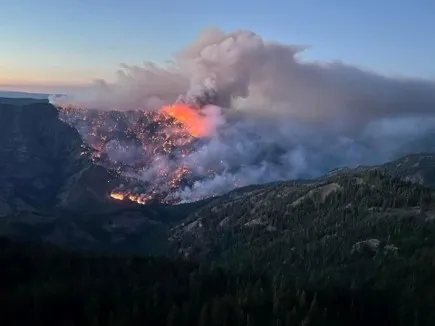
What the tower on Puyallup Ridge actually does is easier to grasp once you understand what radio waves can't do on their own. In mountainous terrain, a direct signal between two radios is blocked by everything in between: ridges, valleys, a wall of old growth. A repeater receives that signal and rebroadcasts it at higher power from an elevated position, effectively vaulting it over the landscape. During fire season, these towers are the nervous system of the entire response.
If you have line of sight to the fire, you have coverage.
No line of sight, no coverage. It's that binary. The system we're heading to serves an enormous footprint: DNR's internal Area network across South Puget Sound, and a State network leased to Fish and Wildlife and Parks, agencies that don't run their own infrastructure. If a crisis demands it, DNR can take over the State repeater entirely. Fifteen technicians hold all of it together.
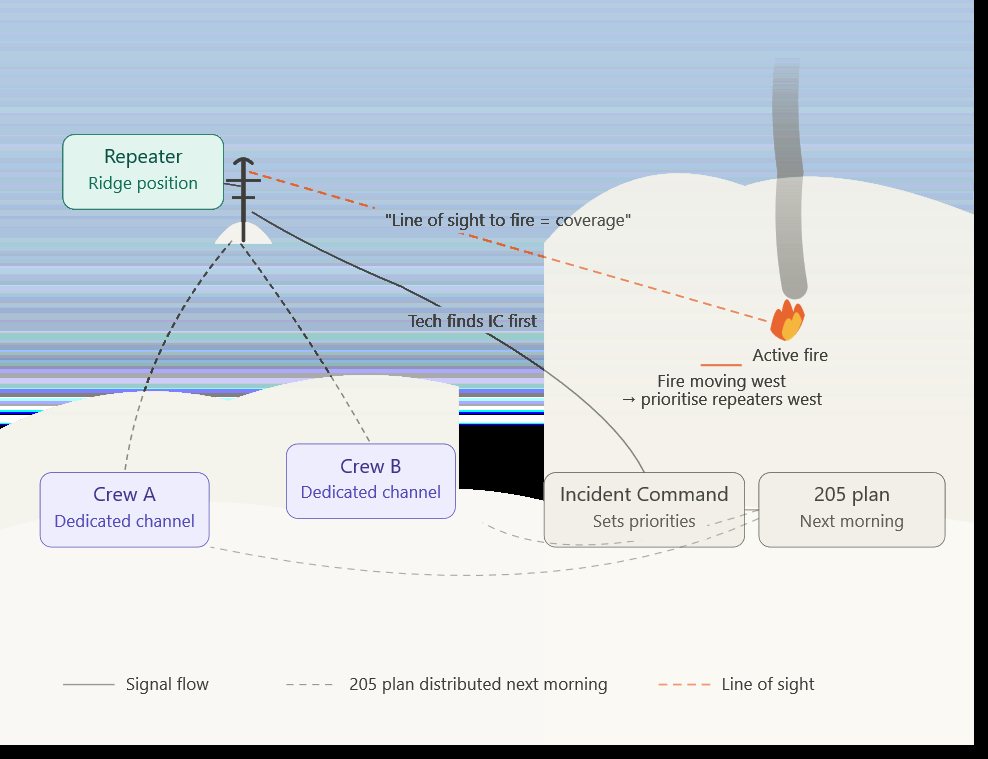
When a fire breaks out, the work moves fast and without much margin. The first job is to find Incident Command and establish the most urgent communications need. Then you calculate which direction the fire is moving. “If it's moving west, prioritize repeaters in that area,” Bryan had said. Extremely dynamic. Changes quickly. He'll often be working alone, or with three others at most. Once the repeaters are positioned, he goes back and starts programming frequencies into a communications plan, a 205, that every crew on the fire receives the next morning. On larger fires, Communications Leaders take command of the whole system, and the techs take their orders from there.
The failures, when they come, are rarely the equipment. “Radio techs are like Sisyphus,” Bryan had said, with the tone of someone who has made peace with this. “Pushing the boulder up the hill.” Most problems are human: crews who don't know how to change channels or zones, firefighters doing radio communications on a fire who don't do it as a day job and can't troubleshoot. He is evangelical about training as the only real fix. He was on one fire where the crew worked 16-hour days for two straight weeks. Sometimes, he told me, Washington burns so broadly that technicians can't leave their own regions at all.
Past Eatonville the road starts climbing and narrowing, the truck working harder, the trailer reminding us it's there. The gate we need to pass through also accesses Mount Rainier National Park and, once through, we're on private land. DNR has leased this site for 70 years at one dollar per year. The land originally belonged to the railroad.
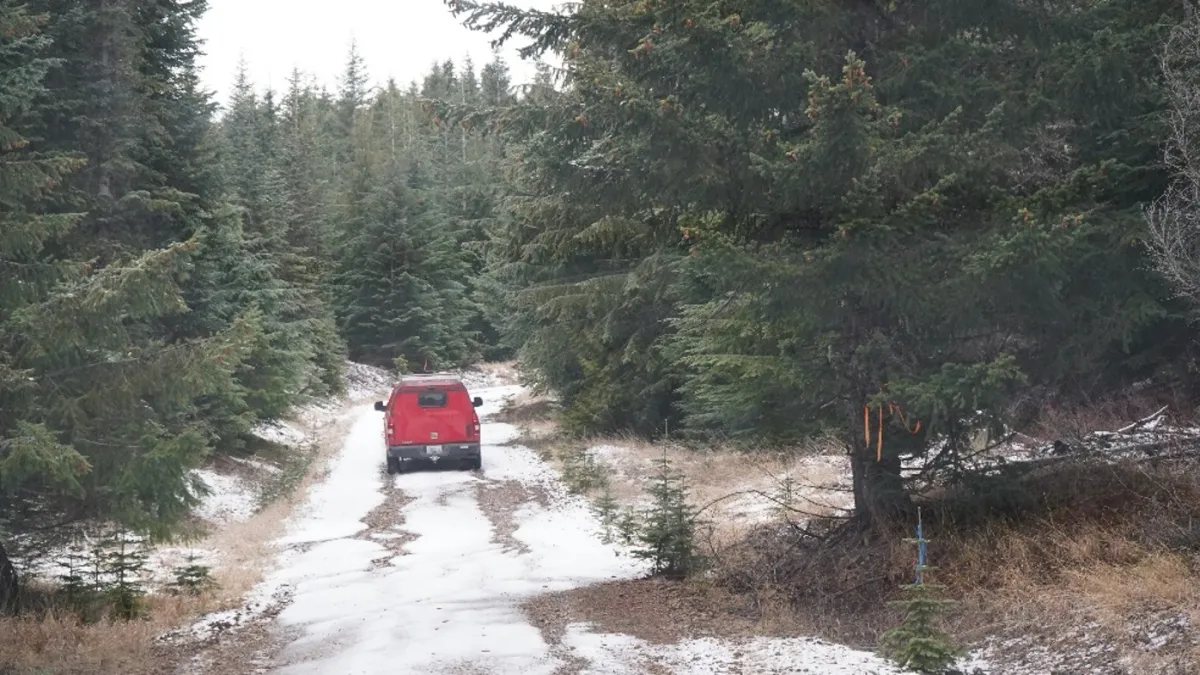
Jarrod tells me about a site called Defiance, off Hood River, that went offline one winter. When the team reached it, the building had almost entirely disappeared into the snow. “All we could see was one top corner of the building sticking out,” he says. They dug down to reach the door. “The door opens out,” he says. “So I really thought we were gonna be there forever.” He says it the way you say something that was genuinely not funny at the time and is only marginally funnier now.
The danger in this work is the distance from help. If something goes wrong on a tower site, and towers are climbed with ropes, at height, in weather, a rope rescue team is coming from Seattle at the closest. That's two hours, minimum. Jarrod's math on a rescue is precise: you need three people. One stays on the ground. One goes up the rope to execute the rescue. The third is implied. All sites have designated landing zones nearby. Team members train in self-rescue and recertify every year. You think about these things before you need them, or you don't work here long.
There's a newer layer to all of this. Pano AI is a camera-based fire detection system that came out of California and approached DNR about placing cameras on their tower sites. The system uses artificial intelligence to distinguish smoke from, say, steam drifting off a nearby industrial plant. Drones assessed the view sheds. Surveys were done. It doesn't always work. Early on there were false alarms, and it turned out the public, who can log into the cameras and watch the feeds themselves, was calling in fires before the AI flagged them. Results were inconsistent. “It's certainly not a replacement for observation,” Jarrod says. He doesn't say it dismissively. He says it like a fact.
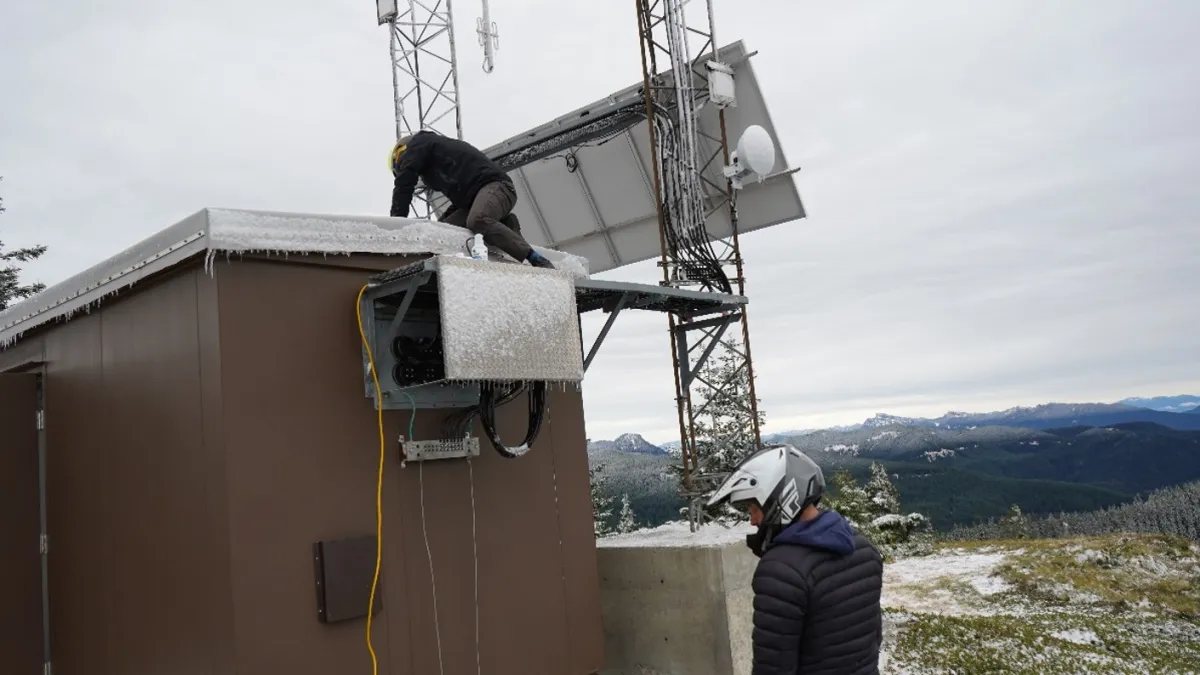
The truck slows. The ridge comes into view through the windshield, the tower visible above the tree line, thin and purposeful against the sky. We pull in. Bryan's truck is already there. The hole in the roof is obvious once you're looking for it. Something came off the tower in a storm and landed precisely wrong. Bryan has never done a TPO patch before. He watched YouTube tutorials the night before. This is not a joke or a confession: it's just how the work gets done out here, two hours from the nearest rope rescue team, on land leased for a dollar a year, holding together the communications network that every firefighter in South Puget Sound depends on when the smoke starts rising.
The snowmobile stays on the trailer. Today, we don't need it.
Next