Tracey Izatt
← All work

Pitch document

Fatal Frontier: Evil in Alaska

Overview

Brief
Sell an eight-part true crime anthology into a network whose slate is already full of true crime. Every pitch in the room has cases, so the difference had to be an argument, made to buyers who sit through dozens of these a year and decide in the first minute.
Approach
Cast Alaska itself as the antagonist and spent the document proving it. Opened on a reframe, so the first sentence carries a whole paragraph. Every statistic serves the thesis; none is there for scale. Built the case on four forces a commissioning editor could repeat to their boss in one breath, which is how a show gets greenlit.
Result
Sold. Premiered on Oxygen as Fatal Frontier: Evil in Alaska on November 14, 2021, produced by RIVR Media.

Selected copy

Subject matter includes violent crime and sexual violence.

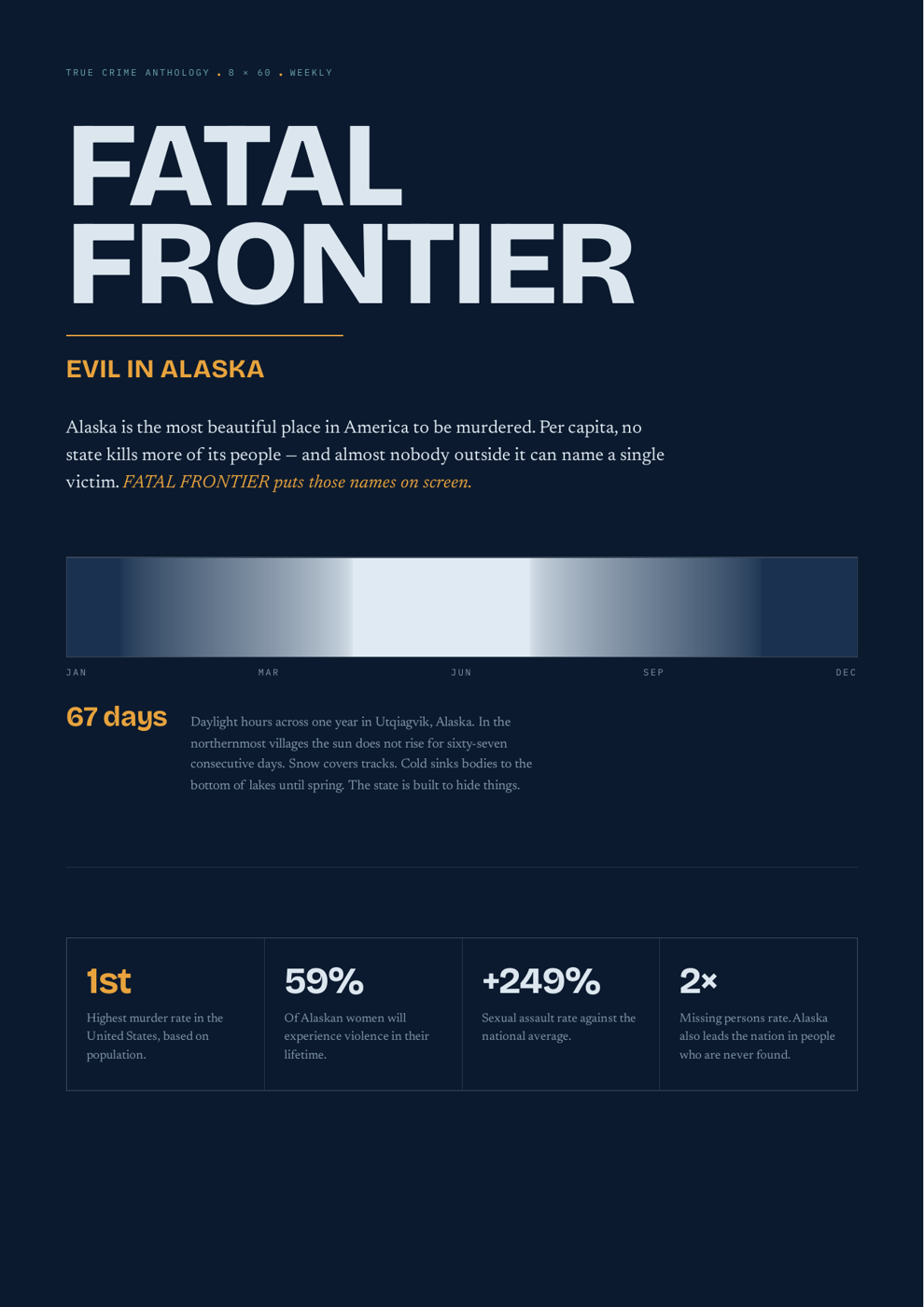
Alaska is the most beautiful place in America to be murdered. Per capita, no state kills more of its people, and almost nobody outside it can name a single victim. Fatal Frontier puts those names on screen.

Logline. A value proposition under a hard character limit. The reframe happens in the first eight words, the gap in the market arrives in the next twenty, and the last sentence says what the show does about it.

Alaska is not the backdrop of this series. It is the reason these crimes happened, the reason they were hard to solve, and in several cases the reason they were solved at all.

Positioning. The whole differentiator in two sentences, structured so the third clause turns the argument.

Alaskans leave each other alone, and they mean it as a courtesy. Applied to a scream in the night, that same instinct becomes a wall investigators have to break through.
Force four of four. A cultural virtue turned into a plot mechanism in thirty-two words.
Cover page of the Fatal Frontier pitch document, dark navy with the title set large in white, a daylight-hours gradient chart and four crime statistics.

Four pages covering the premise, the case for the location, the episode structure, the visual approach and the depth of available cases.

Read the full deck (PDF)

Next

Need a case made to a room that's heard them all?